Bulgarian Sculptor Jivko Works of Art at Ena in Strasbourg
| Strasbourg Strossburi(chiliad) (Alsatian) | |
|---|---|
| Prefecture and district | |
| | |
| Flag Coat of artillery | |
 | |
| Location of Strasbourg | |
| Strasbourg Show map of French republic Strasbourg Prove map of Grand Est | |
| Coordinates: 48°35′00″N 07°44′45″Due east / 48.58333°North seven.74583°E / 48.58333; 7.74583 Coordinates: 48°35′00″N 07°44′45″E / 48.58333°N 7.74583°E / 48.58333; 7.74583 | |
| Country | France |
| Region | Thousand Est |
| Department | Bas-Rhin |
| Arrondissement | Strasbourg |
| Canton | 6 cantons |
| Intercommunality | Eurométropole de Strasbourg |
| Regime | |
| • Mayor (2020-2026) | Jeanne Barseghian (The Greens) |
| Surface area one | 78.26 km2 (30.22 sq mi) |
| • Urban (2017[annotation 1]) | 240.2 kmii (92.7 sq mi) |
| • Metro (2017[note 1]) | 2,197.seven kmii (848.five sq mi) |
| Population (Jan. 2019)[i] | 287,228 |
| • Rank | eighth in France |
| • Density | 3,700/kmtwo (9,500/sq mi) |
| • Urban (2017[ii] [annotation ane]) | 467,438 |
| • Urban density | 1,900/kmtwo (5,000/sq mi) |
| • Metro (2017[3] [notation 1]) | 790,087 |
| • Metro density | 360/km2 (930/sq mi) |
| Time zone | UTC+01:00 (CET) |
| • Summer (DST) | UTC+02:00 (CEST) |
| INSEE/Postal code | 67482 / |
| Dialling codes | 0388, 0390, 0368 |
| Elevation | 132–151 m (433–495 ft) |
| Website | www |
| 1 French Land Annals data, which excludes lakes, ponds, glaciers > ane kmtwo (0.386 sq mi or 247 acres) and river estuaries. | |

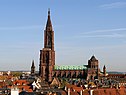





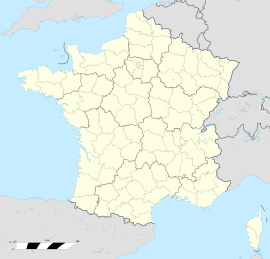


Strasbourg (,[iv] ,[v] French: [stʁasbuʁ] (  listen ); German: Straßburg [ˈʃtʁaːsbʊʁk] ( listen ); Bas Rhin Alsatian: Strossburi [ˈʃd̥ʁɔːsb̥uʁi] ( listen ), Haut Rhin Alsatian: Strossburig [six] [ˈʃd̥ʁɔːsb̥uʁiɡ̊] ( listen )) is the prefecture and largest city of the Grand Est region of eastern France and the official seat of the European Parliament. Located at the border with Federal republic of germany in the historic region of Alsace, it is the prefecture of the Bas-Rhin department.
In 2019, the city proper had 287,228 inhabitants and both the Eurométropole de Strasbourg (Greater Strasbourg) and the Arrondissement of Strasbourg had 505,272 inhabitants.[7] Strasbourg's metropolitan area had a population of 790,087 in 2017, making it the 9th-largest metro surface area in France and home to 13% of the Thou Est region's inhabitants. The transnational Eurodistrict Strasbourg-Ortenau had a population of 958,421 inhabitants.[8] Strasbourg is 1 of the de facto four chief capitals of the European union (alongside Brussels, Luxembourg and Frankfurt), equally it is the seat of several European institutions, such as the European Parliament, the Eurocorps and the European Ombudsman of the European Marriage. An system separate from the European Matrimony, the Council of Europe (with its European Court of Homo Rights, its European Advisers for the Quality of Medicines near ordinarily known in French as "Pharmacopée Européenne", and its European Audiovisual Observatory) is as well located in the metropolis.
Together with Basel (Banking concern for International Settlements), Geneva (United Nations), The Hague (International Court of Justice) and New York City (United Nations globe headquarters), Strasbourg is amid the few cities in the world that is non a state upper-case letter that hosts international organisations of the first order.[9] The city is the seat of many non-European international institutions such as the Key Commission for Navigation on the Rhine and the International Institute of Human being Rights.[10] It is the second city in French republic in terms of international congress and symposia, after Paris. Strasbourg's historic city heart, the Grande Île (Grand Island), was classified a World Heritage Site by UNESCO in 1988, with the newer "Neustadt" being added to the site in 2017.[11] Strasbourg is immersed in Franco-High german civilization and although violently disputed throughout history, has been a cultural bridge between France and Germany for centuries, especially through the University of Strasbourg, currently the second-largest in France, and the coexistence of Cosmic and Protestant civilization. Information technology is too home to the largest Islamic identify of worship in France, the Strasbourg One thousand Mosque.[12]
Economically, Strasbourg is an important centre of manufacturing and engineering science, too as a hub of route, rail, and river transportation. The port of Strasbourg is the second-largest on the Rhine after Duisburg in Frg, and the second-largest river port in France afterwards Paris.[13] [14]
Etymology and names [edit]
Until the fifth century CE, the city was known as Argantorati (in the nominative, Argantorate in the locative), a Celtic Gaulish name Latinised get-go as Argentorate (with Gaulish locative ending, as actualization on the outset Roman milestones in the 1st century CE) and then as Argentoratum (with regular Latin nominative ending, in later on Latin texts). That Gaulish name is a compound of -rati, the Gaulish word for fortified enclosures, cognate to the Old Irish ráth (run into ringfort) and arganto(n)- (cognate to Latin argentum, which gave modern French silver), the Gaulish word for silver, but also any precious metal, particularly gold, suggesting either a fortified enclosure located by a river gold mining site, or hoarding gold mined in the nearby rivers.[fifteen]
Later on the 5th century CE, the metropolis became known by a completely different name which was later Gallicized as Strasbourg (Lower Alsatian: Strossburi; German: Straßburg). That name is of Germanic origin and means 'boondocks (at the crossing) of roads'. The modern Stras- is cognate to the German Straße and English language street, all of which are derived from Latin strata ("paved route"), while -bourg is cognate to the High german Burg and English language borough, all of which are derived from Proto-Germanic *burgz ("colina fort, fortress").
Gregory of Tours was the first to mention the name change: in the tenth book of his History of the Franks written shortly after 590 he said that Egidius, Bishop of Reims, defendant of plotting against Rex Childebert Two of Austrasia in favor of his uncle King Chilperic I of Neustria, was tried by a synod of Austrasian bishops in Metz in Nov 590, found guilty and removed from the priesthood, and so taken "advertizing Argentoratensem urbem, quam nunc Strateburgum vocant" ("to the city of Argentoratum, which they now call Strateburgus"), where he was exiled.[16]
Geography [edit]
Location [edit]

Strasbourg seen from Spot Satellite
Strasbourg is situated at the eastern edge of French republic with Germany. This border is formed by the Rhine, which also forms the eastern edge of the mod city, facing across the river to the German town Kehl. The historic core of Strasbourg, however, lies on the Grande Île in the river Ill, which hither flows parallel to, and roughly 4 kilometres (2.5 mi) from, the Rhine. The natural courses of the two rivers eventually join some distance downstream of Strasbourg, although several artificial waterways at present connect them within the urban center.
The urban center lies in the Upper Rhine Plain, at between 132 metres (433 ft) and 151 metres (495 ft) above sea level, with the upland areas of the Vosges Mountains some xx km (12 mi) to the west and the Black Wood 25 km (16 mi) to the eastward. This department of the Rhine valley is a major axis of northward–south travel, with river traffic on the Rhine itself, and major roads and railways paralleling information technology on both banks.
The city is some 397 kilometres (247 mi) e of Paris.[17] The mouth of the Rhine lies approximately 450 kilometres (280 mi) to the northward, or 650 kilometres (400 mi) as the river flows, whilst the head of navigation in Basel is some 100 kilometres (62 mi) to the southward, or 150 kilometres (93 mi) by river.
Climate [edit]
In spite of its position far inland, Strasbourg has an oceanic climate (Köppen: Cfb),[eighteen] [19] though with less maritime influence than the milder climates of Western and Southern France.[20] The city has warm, relatively sunny summers and cool, overcast winters. Atmospheric precipitation is elevated from mid-spring to the end of summer, simply remains largely constant throughout the year, totaling 631.4 mm (24.9 in) annually. On average, snow falls 30 days per year.[ citation needed ]
The second highest temperature ever recorded was 38.5 °C (101.3 °F) in August 2003, during the 2003 European heat wave. This record was broken, on June 30, 2019, when information technology reached 38.8 °C (101.8 °F).[21] The lowest temperature ever recorded was −23.iv °C (−10.i °F) in Dec 1938.[22]
Strasbourg's location in the Rhine valley, sheltered from potent winds by the Vosges and Black Forest mountains, results in poor natural ventilation, making Strasbourg ane of the most atmospherically polluted cities of France.[23] [24] Nonetheless, the progressive disappearance of heavy industry on both banks of the Rhine, as well as effective measures of traffic regulation in and around the city accept reduced air pollution in recent years.[25]
| Climate data for Strasbourg-Entzheim (SXB), elevation: 150 m (492 ft), 1981–2010 normals, extremes 1924–present | |||||||||||||
|---|---|---|---|---|---|---|---|---|---|---|---|---|---|
| Month | January | February | Mar | April | May | Jun | Jul | Aug | Sep | Oct | Nov | Dec | Yr |
| Record loftier °C (°F) | 17.5 (63.5) | 21.1 (seventy.0) | 26.iii (79.iii) | 30.0 (86.0) | 33.8 (92.8) | 38.8 (101.8) | 38.9 (102.0) | 38.7 (101.vii) | 33.4 (92.1) | 29.ane (84.4) | 22.ane (71.8) | 18.three (64.ix) | 38.ix (102.0) |
| Average loftier °C (°F) | 4.v (xl.1) | 6.4 (43.v) | xi.iv (52.five) | 15.7 (60.iii) | 20.2 (68.4) | 23.iv (74.1) | 25.7 (78.three) | 25.four (77.vii) | 21.0 (69.8) | xv.three (59.5) | viii.8 (47.viii) | 5.two (41.4) | 15.3 (59.5) |
| Daily hateful °C (°F) | ane.viii (35.2) | two.ix (37.2) | 6.9 (44.four) | 10.5 (50.9) | 15.0 (59.0) | 18.one (64.6) | xx.i (68.2) | 19.7 (67.5) | xv.8 (threescore.4) | 11.2 (52.ii) | 5.viii (42.4) | 2.eight (37.0) | 10.ix (51.6) |
| Average low °C (°F) | −0.eight (30.6) | −0.6 (thirty.9) | 2.5 (36.v) | 5.2 (41.4) | 9.viii (49.vi) | 12.eight (55.0) | xiv.v (58.1) | 14.ane (57.4) | x.6 (51.ane) | 7.i (44.8) | 2.8 (37.0) | 0.3 (32.5) | half-dozen.6 (43.9) |
| Tape low °C (°F) | −23.6 (−x.v) | −22.3 (−8.i) | −16.seven (ane.9) | −five.6 (21.nine) | −2.four (27.7) | i.i (34.0) | four.nine (xl.8) | 4.eight (forty.6) | −1.iii (29.7) | −vii.6 (eighteen.3) | −10.8 (12.half-dozen) | −23.iv (−10.1) | −23.6 (−10.5) |
| Average precipitation mm (inches) | 32.2 (i.27) | 34.5 (1.36) | 42.8 (1.69) | 45.nine (1.81) | 81.9 (3.22) | 71.half-dozen (two.82) | 72.7 (2.86) | 61.4 (2.42) | 63.5 (2.l) | 61.5 (2.42) | 47.0 (1.85) | l.0 (1.97) | 665.0 (26.18) |
| Boilerplate precipitation days (≥ one.0 mm) | 8.iv | 8.one | 9.1 | 9.2 | 11.five | ten.vii | 10.eight | 9.9 | 8.half-dozen | 9.five | 9.3 | nine.8 | 114.9 |
| Boilerplate snowy days | vii.viii | half-dozen.7 | 4.0 | 1.5 | 0.i | 0.0 | 0.0 | 0.0 | 0.0 | 0.0 | 3.four | 6.3 | 29.8 |
| Boilerplate relative humidity (%) | 86 | 82 | 76 | 72 | 73 | 74 | 72 | 76 | lxxx | 85 | 86 | 86 | 79 |
| Hateful monthly sunshine hours | 58.1 | 83.eight | 134.8 | 180.0 | 202.five | 223.8 | 228.6 | 219.6 | 164.5 | 98.7 | 55.iii | 43.1 | one,692.7 |
| Source one: Meteo France[26] [27] | |||||||||||||
| Source 2: Infoclimat.fr (relative humidity 1961–1990)[28] | |||||||||||||
History [edit]

The Roman military camp of Argentoratum was beginning mentioned in 12 BC; the urban center of Strasbourg which grew from it historic its 2,000th anniversary in 1988. The fertile surface area in the Upper Rhine Manifestly between the rivers Sick and Rhine had already been populated since the Eye Paleolithic.[29] [xxx]
Between 362 and 1262, Strasbourg was governed by the bishops of Strasbourg; their rule was reinforced in 873 and so more in 982.[31] In 1262, the citizens violently rebelled against the bishop's rule (Battle of Hausbergen) and Strasbourg became a complimentary imperial urban center. Information technology became a French city in 1681, afterward the conquest of Alsace by the armies of Louis XIV. In 1871, after the Franco-Prussian War, the city became German once more, until 1918 (stop of World War I), when it reverted to France. Afterward the defeat of France in 1940 (Globe State of war II), Strasbourg came under German control again through formal annexation into the Gau Baden-Elsaß under the Nazi Gauleiter Robert Wagner; since the stop of 1944, it is once again a French city. In 2016, Strasbourg was promoted from majuscule of Alsace to upper-case letter of Grand Est.
Strasbourg played an important role in Protestant Reformation, with personalities such every bit John Calvin, Martin Bucer, Wolfgang Capito, Matthew and Katharina Zell, but also in other aspects of Christianity such as German mysticism, with Johannes Tauler, Pietism, with Philipp Spener, and Reverence for Life, with Albert Schweitzer. Delegates from the urban center took role in the Protest at Speyer. It was also one of the first centres of the printing industry with pioneers such equally Johannes Gutenberg, Johannes Mentelin, and Heinrich Eggestein. Among the darkest periods in the city's long history were the years 1349 (Strasbourg massacre), 1518 (Dancing plague), 1793 (Reign of Terror), 1870 (Siege of Strasbourg) and the years 1940–1944 with the Nazi occupation (atrocities such equally the Jewish skeleton collection) and the British and American bombing raids. Some other notable dates were the years 357 (Battle of Argentoratum), 842 (Oaths of Strasbourg), 1538 (institution of the academy), 1605 (world'southward first newspaper printed past Johann Carolus), 1792 (La Marseillaise), and 1889 (pancreatic origin of diabetes discovered by Minkowski and Von Mering).
Strasbourg has been the seat of European Institutions since 1949: starting time of the International Committee on Civil Status and of the Quango of Europe, later of the European Parliament, of the European Scientific discipline Foundation, of Eurocorps, and others as well.
Districts [edit]
Strasbourg is divided into the following districts:[32]
- Bourse, Esplanade, Krutenau
- Heart République
- Center Gare
- Conseil des XV, Rotterdam
- Cronenbourg, Hautepierre, Poteries, Hohberg
- Koenigshoffen, Montagne-Verte, Elsau
- Meinau
- Neudorf, Schluthfeld, Port du Rhin, Musau
- Neuhof, Stockfeld, Ganzau
- Robertsau, Wacken
Main sights [edit]

Panorama from the Barrage Vauban with the medieval bridge Ponts Couverts in the foreground (the 4th tower is hidden by trees at the left) and the cathedral in the distance on the right.

La Petite French republic during golden hour
Architecture [edit]

The city is importantly known for its sandstone Gothic Cathedral with its famous astronomical clock, and for its medieval cityscape of Rhineland black and white timber-framed buildings, specially in the Petite France district or Gerberviertel ("tanners' district") alongside the Ill and in the streets and squares surrounding the cathedral, where the renowned Maison Kammerzell stands out.
Notable medieval streets include Rue Mercière, Rue des Dentelles, Rue du Bain aux Plantes, Rue des Juifs, Rue des Frères, Rue des Tonneliers, Rue du Maroquin, Rue des Charpentiers, Rue des Serruriers, Grand' Rue, Quai des Bateliers, Quai Saint-Nicolas and Quai Saint-Thomas. Notable medieval squares include Place de la Cathédrale, Place du Marché Gayot, Place Saint-Étienne, Place du Marché aux Cochons de Lait and Identify Benjamin Zix.

Place du Marché aux Cochons de Lait.

Place Gutenberg with statue of Gutenberg and Carousel.

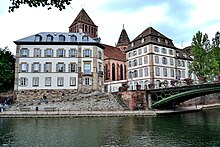
In add-on to the cathedral, Strasbourg houses several other medieval churches that accept survived the many wars and destructions that accept plagued the city: the Romanesque Église Saint-Étienne, partly destroyed in 1944 by Allied bombing raids; the role-Romanesque, office-Gothic, very big Église Saint-Thomas with its Silbermann organ on which Wolfgang Amadeus Mozart and Albert Schweitzer played;[33] the Gothic Église protestante Saint-Pierre-le-Jeune with its crypt dating back to the 7th century and its curtilage partly from the eleventh century; the Gothic Église Saint-Guillaume with its fine early-Renaissance stained glass and furniture; the Gothic Église Saint-Jean; the part-Gothic, office-Art Nouveau Église Sainte-Madeleine etc. The Neo-Gothic church Saint-Pierre-le-Vieux Catholique (there is also an adjacent church Saint-Pierre-le-Vieux Protestant) serves as a shrine for several 15th-century wood-worked and painted altars coming from other, now destroyed churches and installed at that place for public display; peculiarly the Passion of Christ. Among the numerous secular medieval buildings, the monumental Ancienne Douane (old custom-business firm) stands out.
The German Renaissance has ancestral the city some noteworthy buildings (especially the current Chambre de commerce et d'industrie, one-time town hall, on Place Gutenberg), equally did the French Baroque and Classicism with several hôtels particuliers (i.east. palaces), amid which the Palais Rohan (1742, at present housing three museums) is the most spectacular. Other buildings of its kind are the "Hôtel de Hanau" (1736, now the city hall); the Hôtel de Klinglin (1736, now residence of the préfet); the Hôtel des Deux-Ponts (1755, at present residence of the military governor); the Hôtel d'Andlau-Klinglin (1725, now seat of the administration of the Port autonome de Strasbourg) etc. The largest baroque building of Strasbourg though is the 150-metre-long (490 ft) 1720s primary building of the Hôpital ceremonious. As for French Neo-classicism, information technology is the Opera Firm on Place Broglie that virtually prestigiously represents this style.
Strasbourg also offers high-class eclecticist buildings in its very extended German language district, the Neustadt, being the main memory of Wilhelmian architecture since most of the major cities in Germany proper suffered intensive damage during World War II. Streets, boulevards and avenues are homogeneous, surprisingly high (upwards to vii stories) and broad examples of German urban lay-out and of this architectural manner that summons and mixes up v centuries of European compages besides equally Neo-Egyptian, Neo-Greek and Neo-Babylonian styles. The quondam imperial palace Palais du Rhin, the most political and thus heavily criticized of all German Strasbourg buildings epitomizes the thousand scale and stylistic sturdiness of this period. But the two almost handsome and ornate buildings of these times are the École internationale des Pontonniers (the former Höhere Mädchenschule, with its towers, turrets and multiple round and square angles[34] and the Haute école des arts du Rhin with its lavishly ornate façade of painted bricks, woodwork and majolica.[35]

Notable streets of the German district include: Artery de la Forêt Noire, Avenue des Vosges, Avenue d'Alsace, Artery de la Marseillaise, Avenue de la Liberté, Boulevard de la Victoire, Rue Sellénick, Rue du Général de Castelnau, Rue du Maréchal Foch, and Rue du Maréchal Joffre. Notable squares of the German district include Place de la République, Place de 50'Université, Place Brant, and Place Arnold.
Impressive examples of Prussian military machine architecture of the 1880s tin can be establish along the newly reopened Rue du Rempart, displaying big-scale fortifications amidst which the aptly named Kriegstor (war gate).
As for modern and gimmicky architecture, Strasbourg possesses some fine Art Nouveau buildings (such as the huge Palais des Fêtes and houses and villas like Villa Schutzenberger and Hôtel Brion), good examples of mail-World War Ii functional architecture (the Cité Rotterdam, for which Le Corbusier did non succeed in the architectural contest) and, in the very extended Quartier Européen, some spectacular authoritative buildings of sometimes utterly big size, among which the European Court of Human Rights building by Richard Rogers is arguably the finest. Other noticeable gimmicky buildings are the new Music school Cité de la Musique et de la Danse, the Musée d'Fine art moderne et contemporain and the Hôtel du Département facing information technology, as well as, in the outskirts, the tramway-station Hoenheim-Nord designed by Zaha Hadid.
The city has many bridges, including the medieval and four-towered Ponts Couverts that, despite their name, are no longer covered. Next to the Ponts Couverts is the Barrage Vauban, a office of Vauban's 17th-century fortifications, that does include a covered bridge. Other bridges are the ornate 19th-century Pont de la Fonderie (1893, stone) and Pont d'Auvergne (1892, iron), as well every bit architect Marc Mimram's futuristic Passerelle over the Rhine, opened in 2004.
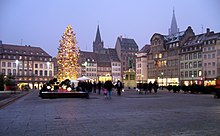
The largest foursquare at the centre of the city of Strasbourg is the Place Kléber. Located in the center of the city's commercial surface area, it was named afterwards general Jean-Baptiste Kléber, born in Strasbourg in 1753 and assassinated in 1800 in Cairo. In the foursquare is a statue of Kléber, under which is a vault containing his remains. On the north side of the square is the Aubette (Orderly Room), built by Jacques François Blondel, builder of the rex, in 1765–1772.
Parks [edit]

The Pavillon Joséphine (rear side) in the Parc de 50'Orangerie
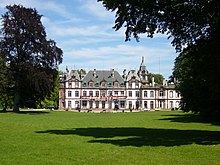
The Château de Pourtalès (front end side) in the park of the same name
Strasbourg features a number of prominent parks, of which several are of cultural and historical involvement: the Parc de fifty'Orangerie, laid out equally a French garden by André le Nôtre and remodeled as an English garden on behalf of Joséphine de Beauharnais, now displaying noteworthy French gardens, a neo-classical castle and a pocket-size zoo; the Parc de la Citadelle, built around impressive remains of the 17th-century fortress erected close to the Rhine by Vauban;[36] the Parc de Pourtalès, laid out in English style around a baroque castle (heavily restored in the 19th century) that now houses a small three-star hotel,[37] and featuring an open-air museum of international contemporary sculpture.[38] The Jardin botanique de l'Université de Strasbourg (botanical garden) was created under the German assistants next to the Observatory of Strasbourg, built in 1881, and even so owns some greenhouses of those times. The Parc des Contades, although the oldest park of the urban center, was completely remodeled after World War Two. The futuristic Parc des Poteries is an example of European park-formulation in the late 1990s. The Jardin des deux Rives, spread over Strasbourg and Kehl on both sides of the Rhine opened in 2004 and is the most extended (lx-hectare) park of the bunch. The virtually recent park is Parc du Heyritz (8,vii ha), opened in 2014 forth a canal facing the hôpital ceremonious.
Museums [edit]
As of 2020, the city of Strasbourg has eleven municipal museums (including Aubette 1928),[39] eleven university museums,[40] and at to the lowest degree 2 privately owned museums (Musée vodou and Musée du barreau de Strasbourg). Five communes in the metropolitan area likewise have museums (come across beneath), three of them dedicated to armed services history.
Overview [edit]
The collections in Strasbourg are distributed over a wide range of museums, co-ordinate to a system that takes into account not only the types and geographical provenances of the items, but also the epochs. This concerns in item the following domains:
- Old master paintings from the Germanic Rhenish territories and until 1681 are displayed in the Musée de l'Œuvre Notre-Dame (MOND); old main paintings from all the rest of Europe (including the Dutch Rhenish territories) and until 1871, as well as old principal paintings from the Germanic Rhenish territories between 1681 and 1871, are displayed in the Musée des Beaux-Arts; paintings since 1871 are displayed in the Musée d'art moderne et contemporain (MAMCS).
- Decorative arts until 1681 are on display in the MOND, decorative arts from the years 1681 until 1871 are on display in the Musée des arts décoratifs, decorative arts after 1871 are on display at the MAMCS, with items from each epoch also shown in the Musée historique.
- Prints and drawings until 1871 are displayed in the Cabinet des estampes et dessins, relieve for the original plans of Strasbourg Cathedral, displayed in the MOND. Prints and drawings afterward 1871 are displayed in the MAMCS, and in the Musée Tomi Ungerer/Heart international de l'illustration (the combined number of prints and drawings amounts to well over 200,000).
- Artefacts from Ancient Egypt are on display in two entirely different collections, one in the Musée archéologique and the other belonging to the Instituts d'Égyptologie et de Papyrologie of the University of Strasbourg.
Art museums [edit]

- The Musée des Beaux-Arts owns paintings by Hans Memling, Francisco de Goya, Tintoretto, Paolo Veronese, Giotto di Bondone, Sandro Botticelli, Peter Paul Rubens, Anthony van Dyck, El Greco, Correggio, Cima da Conegliano and Piero di Cosimo, amongst others.
- The Musée de l'Œuvre Notre-Dame (located in a function-Gothic, part-Renaissance building next to the cathedral) houses a big and renowned drove of medieval and Renaissance upper-Rhenish art, amongst which original sculptures, plans and stained glass from the cathedral and paintings past Hans Baldung and Sebastian Stoskopff.
- The Musée d'Art moderne et contemporain is among the largest museums of its kind in France.
- The Musée des Arts décoratifs, located in the sumptuous former residence of the cardinals of Rohan, the Palais Rohan displays a reputable collection of 18th century furniture and china.
- The Cabinet des estampes et des dessins displays five centuries of engravings and drawings, simply too woodcuts and lithographies.
- The Musée Tomi Ungerer/Heart international de l'illustration, located in a big former villa next to the Theatre, displays original works by Ungerer and other artists (Saul Steinberg, Ronald Searle ... ) as well as Ungerer'south big collection of ancient toys.
Other museums [edit]
- The Musée archéologique presents a large brandish of regional findings from the first ages of human being to the sixth century, focussing especially on the Roman and Celtic period. It also includes a collection of works from Ancient Egypt, and Ancient Greece, assembled and bequeathed past Gustave Schlumberger.[41]
- The Musée alsacien is dedicated to traditional Alsatian daily life.
- Le Vaisseau ("The vessel") is a science and technology centre, especially designed for children.
- The Musée historique (historical museum) is defended to the tumultuous history of the city and displays many artifacts of the times, among which the Grüselhorn, the horn that was blown every evening at x:00, during medieval times, to society the Jews out of the city.
- The Musée vodou (Voodoo museum) opened its doors on 28 November 2013. Displaying a individual collection of artefacts from Haiti, it is located in a one-time water tower (château d'eau) built in 1883 and classified as a Monument historique.
- The Musée du barreau de Strasbourg (The Strasbourg bar association museum) is a museum dedicated to the work and the history of lawyers in the urban center.[42] [43]
University museums [edit]
The Université de Strasbourg is in charge of a number of permanent public displays of its collections of scientific artefacts and products of all kinds of exploration and inquiry.[44]
- The Musée zoologique is one of the oldest in France and is especially famous for its drove of birds. The museum is co-administrated by the municipality.
- The Gypsothèque (also known as Musée des moulages or Musée Adolf Michaelis) is France'due south second-largest cast collection and the largest academy bandage collection in France.
- The Musée de Sismologie et Magnétisme terrestre displays antiquarian instruments of measure.
- The Musée Pasteur is a collection of medical curiosities.
- The Musée de minéralogie is dedicated to minerals.
- The Musée d'Égyptologie houses a collections of archaeological findings fabricated in and brought from Egypt and Sudan. This collection is entirely separate from the Schlumberger drove of the Musée archéologique (encounter above).[45]
- The Crypte aux étoiles ("star crypt") is situated in the vaulted basement beneath the Observatory of Strasbourg and displays sometime telescopes and other antique astronomical devices such as clocks and theodolites.
Museums in the suburbs [edit]
- Musée Les Secrets du Chocolat (Chocolate museum) in Geispolsheim[46]
- Fort Frère in Oberhausbergen[47]
- Fort Rapp in Reichstett
- Pixel Museum, a video game museum, in Schiltigheim[48]
- MM Park France, a military museum, in La Wantzenau[49]
Demographics [edit]
![[icon]](https://upload.wikimedia.org/wikipedia/commons/thumb/1/1c/Wiki_letter_w_cropped.svg/20px-Wiki_letter_w_cropped.svg.png) | This section needs expansion. Yous can help by adding to it. (June 2017) |
The commune of Strasbourg proper had a population of 287,228 on one Jan 2019,[7] the issue of a constant moderate annual growth which is also reflected in the constant growth of the number of students at its university (e. thousand. from 42,000 students in 2010 to 52,000 students in 2019).[50] The metropolitan area of Strasbourg had a population of 785,839 inhabitants in 2016 (French side of the border just),[51] while the transnational Eurodistrict had a population of 958,421 inhabitants.[8]
In the Middle Ages, Strasbourg (a Gratuitous imperial city since 1262), was an important boondocks. According to a 1444 census, the population was circa 20,000; merely one third less than Cologne, then a major European urban center.[52]
Population growth [edit]
|
| ||||||||||||||||||||||||||||||||||||||||||||||||||||||||||||||||||||||||||||||||||||||||||||||||||||||||||||||||||
| Source: EHESS[53] and INSEE (1968-2017)[54] | |||||||||||||||||||||||||||||||||||||||||||||||||||||||||||||||||||||||||||||||||||||||||||||||||||||||||||||||||||

The Ill, seen from the terrace of the Palais Rohan
Population composition [edit]
| 2012 | % | 2007 | % | |
|---|---|---|---|---|
| Total population | 274,394 | 100 | 272,123 | 100 |
| 0–xiv years | 47,473 | 17.3 | 46,263 | 17.0 |
| 15–29 years | 77,719 | 28.iii | 78,291 | 28.8 |
| xxx–44 years | 54,514 | 19.ix | 54,850 | 20.2 |
| 45–59 years | 45,436 | xvi.6 | 47,236 | 17.4 |
| lx–74 years | xxx,321 | 11.i | 27,060 | 9.9 |
| 75+ years | 18,931 | 6.9 | eighteen,424 | half dozen.eight |
Culture [edit]
Strasbourg is the seat of internationally renowned institutions of music and drama:
- The Orchestre philharmonique de Strasbourg, founded in 1855, one of the oldest symphonic orchestras in western Europe. Based since 1975 in the Palais de la musique et des congrès.
- The Opéra national du Rhin
- The Théâtre national de Strasbourg
- The Percussions de Strasbourg
- The Théâtre du Maillon
- The "Laiterie"
- Joshy'due south house - a venue for performance poetry and freestyle urban music.
- Au Zénith
Other theatres are the Théâtre jeune public, the TAPS Scala, the Kafteur ...
Events [edit]
- Musica, international festival of contemporary classical music (autumn)
- Festival international de Strasbourg (founded in 1932), festival of classical music and jazz (summer)
- Festival des Artefacts, festival of contemporary non-classical music
- Les Nuits électroniques de fifty'Ososphère
- Strasbourg European Fantastic Film Festival is an annual moving picture festival devoted to science fiction, horror and fantasy. It was known as the Spectre Film Festival before 2008.
- The Strasbourg International Film Festival is an annual moving-picture show festival focusing on new and emerging contained filmmakers from around the world.
Didactics [edit]
Universities and third educational activity [edit]
Strasbourg, well known as centre of humanism, has a long history of excellence in higher-education, at the crossroads of French and German language intellectual traditions. Although Strasbourg had been annexed past the Kingdom of France in 1683, information technology still remained connected to the High german-speaking intellectual earth throughout the 18th century, and the university attracted numerous students from the Holy Roman Empire, with Goethe, Metternich and Montgelas, who studied law in Strasbourg, amongst the most prominent. With xix Nobel prizes in total, Strasbourg is the most eminent French university exterior of Paris.
Up until January 2009, there were 3 universities in Strasbourg, with an estimate total of 48,500 students every bit of 2007[update] (another 4,500 students are being taught at i of the diverse post-graduate schools):[55]
- Strasbourg I – Louis Pasteur University
- Strasbourg II – Marc Bloch University
- Strasbourg III – Robert Schuman University
Every bit of 1 Jan 2009, those iii universities have merged and at present establish the Université de Strasbourg. Schools office of the Université de Strasbourg include:
- Sciences Po Strasbourg (Institut d'études politiques de Strasbourg), the Academy of Strasbourg's political scientific discipline & international studies heart
- The EMS (EM Strasbourg Business Schoolhouse), the University of Strasbourg'south business concern school
- The INSA (Institut national des sciences appliquées), the University of Strasbourg'south engineering school
- The ENA (École nationale d'administration). ENA trains most of the nation's high-ranking civil servants. The relocation to Strasbourg was meant to give a European vocation to the school and to implement the French government's "décentralisation" program.
- The ESAD (École supérieure des arts décoratifs) is an art school of European reputation.
- The ISEG Group (Institut supérieur européen de gestion group)
- The ISU (International Space University) is located in the south of Strasbourg (Illkirch-Graffenstaden).
- The ECPM (École européenne de chimie, polymères et matériaux)
- The EPITA (École pour l'informatique et les techniques avancées)
- The EPITECH (École cascade l'informatique et les nouvelles technologies)
- The INET (Institut national des études territoriales)
- The IIEF (Institut international d'études françaises)
- The ENGEES (École nationale du génie de 50'eau et de l'environnement de Strasbourg)
- The CUEJ (Centre universitaire d'enseignement du journalisme)
- TÉLÉCOM Physique Strasbourg (École nationale supérieure de physique de Strasbourg), Constitute of Technology, located in the South of Strasbourg (Illkirch-Graffenstaden)
Master and secondary education [edit]
| | This section needs expansion. You can aid by adding to it. (March 2016) |
International schools include:
Multiple levels:
- European School of Strasbourg (priority given to children whose parents are employed at the European institutions)
For elementary teaching:[56]
- École Internationale Robert Schuman
- Strasbourg International School
- International School at Lucie Berger
- Russian Mission School in Strasbourg[57]
For middle schoolhouse/inferior high school education:[56]
- Collège International de l'Esplanade
For senior high school/6th form college:[56]
- Lycée international des Pontonniers (FR)
Libraries [edit]

The Bibliothèque nationale et universitaire (BNU) is, with its collection of more than than 3,000,000 titles,[58] the 2nd-largest library in France after the Bibliothèque nationale de France. It was founded past the High german administration after the complete destruction of the previous municipal library in 1871 and holds the unique status of existence simultaneously a students' and a national library. The Strasbourg municipal library had been marked erroneously equally "Metropolis Hall" in a French commercial map, which had been captured and used by the High german artillery to lay their guns. A librarian from Munich later pointed out "...that the devastation of the precious collection was not the fault of a German arms officer, who used the French map, but of the slovenly and inaccurate scholarship of a Frenchman."[59]
The municipal library Bibliothèque municipale de Strasbourg (BMS) administrates a network of 10 medium-sized librairies in dissimilar areas of the town. A six stories high "Grande bibliothèque", the Médiathèque André Malraux, was inaugurated on 19 September 2008 and is considered the largest in Eastern France.[lx]
Incunabula [edit]
Equally ane of the earliest centers of book-press in Europe (see above: History), Strasbourg for a long time held a large number of incunabula — books printed before 1500 — in its library equally one of its nigh precious heritages: no less than 7,000.[61] After the full destruction of this institution in 1870, nevertheless, a new drove had to be reassembled from scratch. Today, Strasbourg'south different public and institutional libraries again display a sizable total number of incunabula, distributed as follows: Bibliothèque nationale et universitaire, ca. two,120,[61] Médiathèque de la ville et de la communauté urbaine de Strasbourg, 349,[62] Bibliothèque du Grand Séminaire, 238,[63] Médiathèque protestante, 66,[64] and Bibliothèque alsatique du Crédit Mutuel, 5.[65]
Transportation [edit]

Ane of Strasbourg's trams passes over one of its canals, whilst a tourist trip gunkhole passes underneath
Train services operate from the Gare de Strasbourg, the urban center'south main station in the city centre, due east to Offenburg and Karlsruhe in Germany, due west to Metz and Paris, and southward to Basel. Strasbourg'due south links with the residuum of French republic accept improved due to its contempo connectedness to the TGV network, with the first phase of the TGV Est (Paris–Strasbourg) in 2007, the TGV Rhin-Rhône (Strasbourg-Lyon) in 2012, and the second phase of the TGV Est in July 2016.
Strasbourg also has its own airdrome, serving major domestic destinations every bit well as international destinations in Europe and northern Africa. The airport is linked to the Gare de Strasbourg by a frequent train service.[66] [67]
City transportation in Strasbourg includes the futurist-looking Strasbourg tramway that opened in 1994 and is operated by the regional transit company Compagnie des Transports Strasbourgeois (CTS), consisting of half-dozen lines with a full length of 55.8 km (34.seven mi). The CTS also operates a comprehensive coach network throughout the city that is integrated with the trams. With more than than 500 km (311 mi) of bicycle paths, biking in the metropolis is user-friendly and the CTS operates a cheap bike-sharing scheme named Vélhop'. The CTS, and its predecessors, also operated a previous generation of tram organization between 1878 and 1960, complemented by trolleybus routes betwixt 1939 and 1962.
Beingness a metropolis on the Ill and shut to the Rhine, Strasbourg has e'er been an important heart of fluvial navigation, as is attested by archeological findings. In 1682 the Canal de la Bruche was added to the river navigations, initially to provide transport for sandstone from quarries in the Vosges for use in the fortification of the metropolis. That culvert has since closed, simply the subsequent Culvert du Rhône au Rhin, Canal de la Marne au Rhin and 1000 Canal d'Alsace are all the same in use, as is the important activity of the Port autonome de Strasbourg. Water tourism inside the city proper attracts hundreds of thousands of tourists yearly.
The tram organisation that now criss-crosses the historic city centre complements walking and biking in it. The middle has been transformed into a pedestrian priority zone that enables and invites walking and biking by making these active modes of transport comfy, safe and enjoyable. These attributes are accomplished by applying the principle of "filtered permeability" to the existing irregular network of streets. It means that the network adaptations favour agile transportation and, selectively, "filter out" the motorcar by reducing the number of streets that run through the center. While certain streets are discontinuous for cars, they connect to a network of pedestrian and cycle paths which permeate the unabridged eye. In improver, these paths go through public squares and open up spaces increasing the enjoyment of the trip. This logic of filtering a mode of ship is fully expressed in a comprehensive model for laying out neighbourhoods and districts – the Fused Grid.
At present the A35 autoroute, which parallels the Rhine betwixt Karlsruhe and Basel, and the A4 autoroute, which links Paris with Strasbourg, penetrate shut to the centre of the city. The Grand contournement ouest (GCO) project, programmed since 1999, planned to construct a 24-kilometre-long (15 mi) highway connection between the junctions of the A4 and the A35 autoroutes in the n and of the A35 and A352 autoroutes in the south. This routes well to the west of the metropolis in order to divest a pregnant portion of motorized traffic from the unité urbaine.[68] The GCO project was opposed by environmentalists, who created a ZAD (or Zone to Defend).[69] After much delay, the GCO was finally inaugurated on 11 Dec 2021.[70]
Strasbourg Public Transportation Statistics [edit]
The average amount of fourth dimension people spend commuting with public transit in Strasbourg, for example to and from work, on a weekday is 52 min. 7% of public transit riders, ride for more than than 2 hours every 24-hour interval. The average amount of time people await at a terminate or station for public transit is 9 min, while 11% of riders wait for over 20 minutes on boilerplate every day. The average altitude people usually ride in a single trip with public transit is 3.ix km (2.4 mi), while 0% travel for over 12 km (7.v mi) in a single direction.[71]
European office [edit]
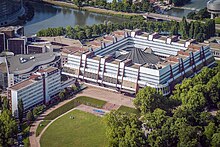
Institutions [edit]
Strasbourg is the seat of over twenty international institutions,[72] nigh famously of the Council of Europe and of the European Parliament, of which it is the official seat. Strasbourg is considered the legislative and democratic uppercase of the European Union, while Brussels is considered the executive and administrative capital and Grand duchy of luxembourg the judiciary and fiscal capital.[73]
Strasbourg is the seat of the post-obit organisations, among others:
- Central Committee for Navigation on the Rhine (since 1920)
- Council of Europe with all the bodies and organisations affiliated to this institution (since 1949)
- European Parliament (since 1952)
- European Ombudsman
- Eurocorps headquarters,
- Franco-German television channel Arte
- European Scientific discipline Foundation
- International Institute of Human Rights
- Human Frontier Science Program
- International Commission on Civil Condition
- Assembly of European Regions
- Centre for European Studies (French: Centre d'études européennes de Strasbourg)
- Sakharov Prize
Eurodistrict [edit]
French republic and Frg take created a Eurodistrict straddling the Rhine, combining the Greater Strasbourg and the Ortenau district of Baden-Württemberg, with some mutual administration. It was established in 2005 and has been fully functional since 2010.
Sports [edit]

Sporting teams from Strasbourg are the Racing Club de Strasbourg Alsace (football), SIG Strasbourg (basketball game) and the Étoile Noire (ice hockey).[74] The women's lawn tennis Internationaux de Strasbourg is i of the most important French tournaments of its kind exterior Roland-Garros. In 1922, Strasbourg was the venue for the XVI Grand Prix de l'A.C.F. which saw Fiat battle Bugatti, Election, Rolland Pilain, and Britain'south Aston Martin and Sunbeam.
The city is home to SN Strasbourg, a First division h2o polo team that plays its abode games at the Piscine de la Kibitzenau.
Honours [edit]
Honours associated with the urban center of Strasbourg.
- The Medal of Honor Strasbourg
- Sakharov Prize seated in Strasbourg
- City of Strasbourg Silver (gilt) Medal, a erstwhile medal with City Coat of Arms and Ten Arms of the Cities of the Dekapolis[75]
Notable people [edit]
In chronological order, notable people built-in in Strasbourg include: Eric of Friuli, Johannes Tauler, Sebastian Brant, Jean Baptiste Kléber, Louis Ramond de Carbonnières, François Christophe Kellermann, Marie Tussaud, Ludwig I of Bavaria, Charles Frédéric Gerhardt, Louis-Frédéric Schützenberger, Gustave Doré, Émile Waldteufel, René Beeh, Jean/Hans Arp, Charles Münch, Hans Bethe, Maurice Kriegel-Valrimont, Marcel Marceau, Tomi Ungerer, Elizabeth Sombart, Arsène Wenger, Petit and Matt Pokora.
In chronological guild, notable residents of Strasbourg include: Johannes Gutenberg, Hans Baldung, Martin Bucer, John Calvin, Joachim Meyer, Johann Carolus, Johann Wolfgang Goethe, Jakob Michael Reinhold Lenz, Klemens Wenzel von Metternich, Georg Büchner, Louis Pasteur, Ferdinand Braun, Albrecht Kossel, Georg Simmel, Albert Schweitzer, Otto Klemperer, Marc Bloch, Alberto Fujimori, Marjane Satrapi, Paul Ricœur and Jean-Marie Lehn.
Twin towns and sis cities [edit]
Strasbourg is twinned with:[76]
-
 Boston, United states, since 1960[76] [77]
 -
 Leicester, Britain, since 1960[76] [78] [79]
 -
 Stuttgart, Germany, since 1962[76] [lxxx]
 - Dresden, Deutschland, since 1990[76] [81]
-
 Ramat Gan, Israel, since 1991[76] [82]
 -
 Oran, People's democratic republic of algeria, since 2013
Strasbourg has cooperative agreements with:
In pop civilization [edit]
In film [edit]
- The opening scenes of the 1977 Ridley Scott motion picture The Duellists take place in Strasbourg in 1800.
- The 2007 picture show In the City of Sylvia is prepare in Strasbourg.
- Early on Feb 2011, main photography for Sherlock Holmes: A Game of Shadows (2011) moved for two days to Strasbourg. Shooting took place on, effectually, and within the Strasbourg Cathedral. The opening scene of the pic covers an bump-off-bombing in the city.
In literature [edit]
- One of the longest chapters of Laurence Sterne's novel Tristram Shandy (1759–1767), "Slawkenbergius' tale", takes place in Strasbourg.[83]
- An episode of Matthew Gregory Lewis' novel The Monk (1796) takes place in the forests then surrounding Strasbourg.
In music [edit]
- Wolfgang Amadeus Mozart called his Tertiary violin concerto (1775) Straßburger Konzert considering of 1 of its well-nigh prominent motives, based on a local, minuet-like trip the light fantastic toe that had already appeared as a tune in a symphony by Carl Ditters von Dittersdorf.[84] It is not related to Mozart'due south ulterior stay in Strasbourg (1778), where he gave iii concert performances on the piano.
- Havergal Brian's Symphony No. 7 was inspired by passages in Goethe's memoirs recalling his time spent at Strasbourg University. The piece of work ends with an orchestral bong sounding the notation E, the strike-note of the bell of Strasbourg Cathedral.
- British art-punk band The Rakes had a minor hit in 2005 with their vocal "Strasbourg". This song features witty lyrics with themes of espionage and vodka and includes a count of 'eins, zwei, drei, vier!!', fifty-fifty though Strasbourg's spoken language is French.
- On their 1974 album Hamburger Concerto, Dutch progressive band Focus included a track called "La Cathédrale de Strasbourg", which included chimes from a cathedral-like bong.
- Strasbourg pie, a dish containing foie gras, is mentioned in the finale of the Andrew Lloyd Webber musical Cats.
- Several works take specifically been dedicated to Strasbourg Cathedral, notably advertising hoc compositions (masses, motets etc.) past Kapellmeisters Franz Xaver Richter and Ignaz Pleyel and, more recently, It is Finished past John Tavener.
Notes [edit]
- ^ a b c d Only the part of the urban surface area on French territory.
References [edit]
Citations [edit]
- ^ "Populations légales 2019". The National Institute of Statistics and Economic Studies. 29 December 2021.
- ^ "Unité urbaine de Strasbourg (partie française) (67701)". insee.fr . Retrieved 24 September 2020.
- ^ "Aire urbaine de Strasbourg (partie française) (009)". insee.fr . Retrieved 24 September 2020.
- ^ "Strasbourg". Oxford Dictionaries United kingdom of great britain and northern ireland English Lexicon. Oxford University Printing. due north.d. Retrieved thirty April 2019.
- ^ "Strasbourg". Merriam-Webster Dictionary . Retrieved 30 April 2019.
- ^ Office cascade la Langue et la Civilisation d'Alsace. "Strasbourg". oclalsace.org (in French). Retrieved 11 June 2019. .
- ^ a b "Populations légales en vigueur à compter du 1er janvier 2022" (PDF). Institut national de la statistique et des études économiques. Retrieved 16 January 2022.
- ^ a b "Territoire". Eurodistrict Strasbourg-Ortenau. Retrieved two January 2020.
- ^ "Archived copy". Archived from the original on xi June 2007. Retrieved 10 December 2019.
{{cite spider web}}: CS1 maint: archived re-create as title (link) - ^ "The international institute of Human Rights". Archived from the original on 3 June 2013. Retrieved 31 August 2013.
- ^ "Strasbourg, Grande-Île and Neustadt". UNESCO Earth Heritage Centre. United nations Educational, Scientific, and Cultural Organisation. Retrieved 17 Oct 2021.
- ^ "France Vows to Kick out Islamic Troublemakers". Naharnet. 27 September 2012.
- ^ "Le Port Autonome de Strasbourg". upper-rhine-ports.eu . Retrieved 4 Jan 2020.
- ^ "Port de Strasbourg: le trafic chute de 26% en 2018, plus bas historique". Le Figaro. 15 January 2019. Retrieved iv January 2020.
- ^ Jean-Marie Pailler (2006). "Quand l'silver était d'or. Paroles de Gaulois" (PDF). Gallia (in French). CNRS. 63: 211–241. doi:10.3406/galia.2006.3296.
- ^ Gregory of Tours (1849). Historia Francorum. Vol. tenth book, chapter XIX. p. 553. Retrieved 7 March 2017.
- ^ "Distance entre Paris et Strasbourg en voiture". frdistance.com (in French). Retrieved eighteen December 2018.
- ^ "Strasbourg Climate Strasbourg Temperatures Strasbourg Weather Averages". Archived from the original on 24 June 2017. Retrieved 29 September 2017.
- ^ "Temperature, Climate graph, Climate table for Strasbourg". Climate-Data . Retrieved 29 September 2017.
- ^ "Les climats en France - Ressources cascade les enseignants - Ressources élémentaire". www.assistancescolaire.com (in French). Retrieved 30 March 2019.
- ^ "Canicule de juin 2019 : retour sur united nations épisode exceptionnel". www.meteofrance.fr. Meteo-French republic. Archived from the original on iii July 2019. Retrieved 3 July 2019.
- ^ "Record de froid: -18 degrés à Strasbourg cette nuit". Les Dernières Nouvelles d'Alsace. 25 December 2010. Retrieved 13 Jan 2021.
- ^ "Daily measurements for Strasbourg and Alsace". Atmo-alsace.internet. Retrieved 15 April 2010.
- ^ Measurements Archived 9 October 2007 at the Wayback Auto made on 18 and 19 October 2005
- ^ "Outlines of the urban transportation policy led by the urban community of Strasbourg". Epe.be. 29 March 2010. Archived from the original on eleven December 2008. Retrieved fifteen Apr 2010.
- ^ "Climatological Information for Strasbourg, France". Meteo France. vii August 2019. Archived from the original on 27 September 2019. Retrieved 28 January 2022.
- ^ "STRASBOURG–ENTZHEIM (67)" (PDF). Fiche Climatologique: Statistiques 1981–2010 et records (in French). Meteo France. Retrieved seven Baronial 2019.
- ^ "Normes et records 1961–1990: Strasbourg-Entzheim (67) – altitude 150m" (in French). Infoclimat. Archived from the original on 15 March 2016. Retrieved seven August 2019.
- ^ "Musée Archéologique - Strasbourg De la Préhistoire au Moyen-Âge en Alsace". Hominidés.com . Retrieved 17 July 2017.
- ^ "Du Paléolithique au Néolithique". Musées de la ville de Strasbourg. Retrieved 29 January 2019.
- ^ "Les temps de l'histoire de Strasbourg". Archives de la ville et de fifty'Eurométropole de Strasbourg. Retrieved 17 July 2017.
- ^ "Les quartiers".
- ^ "History and description of the instrument". Perso.wanadoo.fr. Archived from the original on 30 November 2004. Retrieved 15 April 2010.
- ^ "Pictures". Archi-strasbourg.org. Archived from the original on five Jan 2009. Retrieved 15 Apr 2010.
- ^ "Views". Archived from the original on x May 2015. Retrieved 20 August 2021.
- ^ "Parc de la Citadelle with remains of the Vauban fortress". Archi-strasbourg.org. 26 August 2007. Archived from the original on v January 2009. Retrieved 15 April 2010.
- ^ "Overview". chateau-pourtales.european union. Retrieved 12 December 2010.
- ^ "Overview". Ceaac.org. Archived from the original on four December 2010. Retrieved fifteen Apr 2010.
- ^ "Museums". Musées de la ville de Strasbourg. Retrieved 3 January 2020.
- ^ "Jardin des Sciences - Et aussi". University of Strasbourg. Retrieved 3 January 2020.
- ^ "Antiquités égyptiennes Musée Archéologique". Musées de la vile de Strasbourg. Retrieved iii January 2020.
- ^ "Le Musée du Barreau de Strasbourg". Ordre des avocats de Strasbourg. Archived from the original on i December 2017. Retrieved 1 December 2017.
- ^ "Le Musée du Barreau de Strasbourg". Alsace 20. Archived from the original on one December 2017. Retrieved 1 December 2017.
- ^ "Overview of the collections". Collections.u-strasbg.fr. Archived from the original on 9 November 2013. Retrieved 9 December 2013.
- ^ "Histoire de la collection". University of Strasbourg. Retrieved three Jan 2020.
- ^ "The Museum "The Secrets of Chocolate"". musee-du-chocolat.com . Retrieved 3 March 2017.
- ^ "Fort Großherzog von Baden - Fort Frère". Fort Frère . Retrieved sixteen May 2017.
- ^ "Pixel Museum". pixel-museum.fr . Retrieved 3 March 2017.
- ^ "MM Park France". mmpark.fr . Retrieved 3 March 2017.
- ^ "Effectifs étudiants". Academy of Strasbourg. Retrieved 3 January 2020.
- ^ "Aire urbaine de Strasbourg (partie française) (009)". INSEE. Retrieved 2 Jan 2020.
- ^ Klipfel, Monique. "L'importance démographique de la ville". Académie de Strasbourg. Retrieved 4 January 2020.
- ^ Des villages de Cassini aux communes d'aujourd'hui: Commune data sheet Strasbourg, EHESS. (in French)
- ^ Population en historique depuis 1968, INSEE
- ^ "Fifty'enseignement universitaire en Alsace". 12 October 2007. Archived from the original on 12 Oct 2007. Retrieved iii June 2011.
- ^ a b c "International schooling in Strasbourg" (Archive). City of Strasbourg. Retrieved on 28 March 2016. p. one.
- ^ "Контакты." Russian Mission School in Strasbourg. Retrieved on March 28, 2016. "half-dozen, alle'due east de la Robertsau, 67000, Strasbourg"
- ^ "Figures". Bnu.fr. Archived from the original on iv December 2010. Retrieved 15 April 2010.
- ^ Butler, Pierce. 1945. Books and libraries in wartime. Chicago, IL: University of Chicago Press. p. 15
- ^ Strasbourg ouvre une grande médiathèque sur le port in Fifty'Express (in French)
- ^ a b "Les incunables" (in French). Bibliothèque nationale et universitaire de Strasbourg. Retrieved 9 January 2020.
- ^ "Présentation des Fonds patrimoniaux" (in French). Portail des médiathèques de la ville et de 50'Eurométropole de Strasbourg. Retrieved nine January 2020.
- ^ "La bibliothèque ancienne du G Séminaire" (in French). Séminaire Sainte Marie Majeure - Diocèse de Strasbourg. 27 October 2014. Retrieved 12 December 2014.
- ^ "La Médiathèque Protestante". Chapitre de Saint-Thomas. Retrieved nine Jan 2020.
- ^ "Général". Bacm.creditmutuel.fr. Archived from the original on nine September 2010. Retrieved sixteen June 2009.
- ^ "Destination map". Aéroport Strasbourg. Archived from the original on 18 September 2015. Retrieved 18 September 2015.
- ^ "Shuttle railroad train". Aéroport Strasbourg. Archived from the original on 18 September 2015. Retrieved 18 September 2015.
- ^ Grand Contournement Ouest de Strasbourg (in French) [ dead link ]
- ^ Caravagna, Léo (7 February 2017). "Strasbourg : une ébauche de ZAD contre le projet de grand contournement ouest". Le Figaro . Retrieved five May 2019.
- ^ "Suivez en straight l'inauguration du GCO". Les Dernières Nouvelles d'Alsace. Retrieved 11 Dec 2021.
- ^ "Strasbourg Public Transportation Statistics". Global Public Transit Alphabetize past Moovit. Retrieved 19 June 2017.
 Material was copied from this source, which is available nether a Creative Commons Attribution iv.0 International License.
 - ^ "Listing of international institutions in Strasbourg". Investir-strasbourg.com. 15 January 2003. Archived from the original on 10 March 2010. Retrieved 15 Apr 2010.
- ^ "Comparative Law Academy: the ECHR and the FCC". The Brief. 24 May 2011. Retrieved 13 October 2016.
- ^ "Etoile Noire de Strasbourg". Etoile-noire.fr. 31 May 2009. Archived from the original on eight March 2019. Retrieved 16 June 2009.
- ^ "Cache Numismatics - All Things Numismatic".
- ^ a b c d due east f "Strasbourg, Twin Metropolis". Strasbourg.eu & Communauté Urbaine. Archived from the original on 28 July 2013. Retrieved 21 August 2013.
- ^ "Boston Sister Cities". The City of Boston. Archived from the original on 8 February 2009. Retrieved five April 2009.
- ^ "British towns twinned with French towns". Archant Community Media Ltd . Retrieved 11 July 2013.
- ^ "Twinning". Leicester Urban center council. Archived from the original on 2 October 2010. Retrieved v February 2010.
- ^ "Stuttgart Städtepartnerschaften". Landeshauptstadt Stuttgart, Abteilung Außenbeziehungen (in German). Retrieved 27 July 2013.
- ^ "Dresden – Partner Cities". 2008 Landeshauptstadt Dresden. Archived from the original on sixteen October 2008. Retrieved 29 December 2008.
- ^ "Ramat Gan Sis Cities". Archived from the original on vii March 2008. Retrieved half-dozen Apr 2008.
- ^ "Full text". Tristramshandyweb.it. Archived from the original on 19 July 2011. Retrieved 15 Apr 2010.
- ^ Lempfrid, Wolfgang. "Wolfgng Amadeus Mozart: Konzert für Violine und Orchester in D-Dur, KV 218". koelnklavier.de. Retrieved v April 2016.
Sources [edit]
- Connaître Strasbourg by Roland Recht, Georges Foessel and Jean-Pierre Klein, 1988, ISBN ii-7032-0185-0.
- Histoire de Strasbourg des origines à nos jours, four volumes (ca. 2000 pages) by a collective of historians under the guidance of Georges Livet and Francis Rapp, 1982, ISBN 2-7165-0041-Ten.
External links [edit]
 | Wikimedia Eatables has media related to Strasbourg. |
- Strasbourg municipality website
- Tourist office of Strasbourg
- CTS – Compagnie des transports strasbourgeois
- The museums of Strasbourg
- The city athenaeum of Strasbourg (in French)
Source: https://en.wikipedia.org/wiki/Strassbourg
0 Response to "Bulgarian Sculptor Jivko Works of Art at Ena in Strasbourg"
Post a Comment